There is a wide range for choosing the necessary plane
components, there are a lot of specialized websites and lots of manufacturers
and varieties.
Hobbyking.com has a huge database of all these components
and more, so it’s the chosen one to take the information from. For cameras and extras, Nitroplanes.com is another useful website.
The plane will need:
- Servos (2 x Aileron, 1 x Elevator, 1 x Rudder):
14.4g, 25x19.6x8
2.51€
.jpg)
www.hobbyking.com/hobbyking/store/__3715__Hobby_King_S0361_3_6g_45kg_12sec_Micro_Servo.html
9 g, Size : 21x12x22 mm
2.1€

www.hobbyking.com/hobbyking/store/__662__HXT900_9g_1_6kg_12sec_Micro_Servo.html
17.4g, Size: 26x13x26
13.03€
17.4g, Size: 26x13x26
13.03€
.jpg)
www.hobbyking.com/hobbyking/store/__8760__Turnigy_380MAX_Micro_Servo_Metal_Gear_4_1kg_16sec_17_4g.html
51g, 44x40x20
5.15€
51g, 44x40x20
5.15€
.jpg)
www.hobbyking.com/hobbyking/store/__16266__HK15288A_Analog_BB_MG_Servo_51g_9kg_0_20s.html
·
1 x Electronic speed controller (ESC)
32
g, Size: 54 x 26 x 11mm
.jpg)
www.hobbyking.com/hobbyking/store/__15205__Hobby_King_30A_ESC_3A_UBEC.html
25g, size: 50x26x12
10.1€
25g, size: 50x26x12
10.1€

http://www.hobbyking.com/hobbyking/store/__11617__Turnigy_AE_30A_Brushless_ESC.html
25g, Size 45x24x11
10.26€
25g, Size 45x24x11
10.26€

http://www.hobbyking.com/hobbyking/store/__2164__TURNIGY_Plush_30amp_Speed_Controller.html
33g, 55x28x13
17,15€
33g, 55x28x13
17,15€

http://www.hobbyking.com/hobbyking/store/__2165__TURNIGY_Plush_40amp_Speed_Controller.html
35g, size: 60x28x10
15.52€
35g, size: 60x28x10
15.52€

http://www.hobbyking.com/hobbyking/store/__39566__Corona_40A_Brushless_Speed_Controller_2_6s_3A_UBEC.html
54g, size 45.5x33x23
17.8€
54g, size 45.5x33x23
17.8€

http://www.hobbyking.com/hobbyking/store/__16364__Turnigy_dlux_40A_SBEC_Brushless_Speed_Controller_w_Data_Logging.html
38g, size: 59x27x12
24,65€
38g, size: 59x27x12
24,65€

http://www.hobbyking.com/hobbyking/store/__8922__TURNIGY_K_Force_40A_Brushless_ESC.html
61g, size: 70x32x17mm
14.24€
61g, size: 70x32x17mm
14.24€

http://www.hobbyking.com/hobbyking/store/__16892__Hobby_King_60A_ESC_4A_UBEC.html
·
Battery (choose one of the best, crucial
component):
-
NiMh, Nickel Metal hybrid: less powerful, less
expensive.
-
NiCad, Nickel Cadmium: less power, more battery
life, heavier.
-
LiPo, Lithium Polymer: both light weight and
long lasting, more expensive.
Things to know about batteries:
2000mAh is the capacity and the most important figure.
Fully charged: 4.2 V (in each cell). Discharged: 3.0 V (in each cell).
A battery with a discharge rating of 10C would mean you could theoretically & safely discharge it at a rate 10 times more than the capacity of the pack (15C pack = 15 times more or 1C discharges the battery in 1/1 hours or 1 hour and 2C discharges the battery in ½ hour). A 2000mAh cell discharged at 6 amps is being discharged at 3C (2000mA x 3).
If you have 2 2000mAh cells and you wire them in parallel then the result is the same as 1 4000mAh cell (it has the same C rating as the original 2000mAh cells did). Thus if the 2000mAh cells could discharge at a maximum of 5C, or 10 amps then the new 4000mAh cell can also discharge at 5C or (4000mA x 5) 20 amps. This method of battery pack building allows us to use LiPo batteries at higher currents than single cells could produce.
If you get a pack with a C discharge rating at least double of the maximum you intend to pull out of it; with proper care, there's no reason you shouldn't be able to get at least 400 charge and discharge cycles out of it with average degradation.
The XSXP method: for example a 3S4P pack of 2100mAh cells has a total of 12 cells inside. It will have the voltage of any other 3S pack since the number of cells in series determines the voltage. It will have the current handling of 4 times the maximum C rating of the 12 individual cells. So say our 3S4P pack had a maximum discharge of 6C. That means that it has a nominal voltage of 10.8 volts (3x3.6) and a maximum discharge rate of 50.4 amps (2100mAh x 6Cx4P).
Important to use a programmable ESC since the correct voltage cutoff is critical to the life of the batteries. Use the ESC's programming mode to set the LVC to 3.0 volts per cell with a hard cutoff, or 3.3 volts per cell with a soft cutoff. If the ESC has an automatic lithium mode. Use it, it will correctly sense the number of cells and set the auto cutoff appropriately.
Performance graphs from manufacturer. Looking at how low the voltage of the cell drops at various amperages will give you a metric to compare that battery to similar size/weight batteries.
(http://diydrones.com/profiles/blogs/complete-guide-on-lipo-batteries)
(http://www.rchelicopterfun.com/rc-lipo-batteries.html)
2000mAh is the capacity and the most important figure.
Fully charged: 4.2 V (in each cell). Discharged: 3.0 V (in each cell).
A battery with a discharge rating of 10C would mean you could theoretically & safely discharge it at a rate 10 times more than the capacity of the pack (15C pack = 15 times more or 1C discharges the battery in 1/1 hours or 1 hour and 2C discharges the battery in ½ hour). A 2000mAh cell discharged at 6 amps is being discharged at 3C (2000mA x 3).
If you have 2 2000mAh cells and you wire them in parallel then the result is the same as 1 4000mAh cell (it has the same C rating as the original 2000mAh cells did). Thus if the 2000mAh cells could discharge at a maximum of 5C, or 10 amps then the new 4000mAh cell can also discharge at 5C or (4000mA x 5) 20 amps. This method of battery pack building allows us to use LiPo batteries at higher currents than single cells could produce.
If you get a pack with a C discharge rating at least double of the maximum you intend to pull out of it; with proper care, there's no reason you shouldn't be able to get at least 400 charge and discharge cycles out of it with average degradation.
The XSXP method: for example a 3S4P pack of 2100mAh cells has a total of 12 cells inside. It will have the voltage of any other 3S pack since the number of cells in series determines the voltage. It will have the current handling of 4 times the maximum C rating of the 12 individual cells. So say our 3S4P pack had a maximum discharge of 6C. That means that it has a nominal voltage of 10.8 volts (3x3.6) and a maximum discharge rate of 50.4 amps (2100mAh x 6Cx4P).
Important to use a programmable ESC since the correct voltage cutoff is critical to the life of the batteries. Use the ESC's programming mode to set the LVC to 3.0 volts per cell with a hard cutoff, or 3.3 volts per cell with a soft cutoff. If the ESC has an automatic lithium mode. Use it, it will correctly sense the number of cells and set the auto cutoff appropriately.
Performance graphs from manufacturer. Looking at how low the voltage of the cell drops at various amperages will give you a metric to compare that battery to similar size/weight batteries.
(http://diydrones.com/profiles/blogs/complete-guide-on-lipo-batteries)
(http://www.rchelicopterfun.com/rc-lipo-batteries.html)

electronics.stackexchange.com/questions/64056/calculating-useable-amps
User “henkvdw” at fpvlab.com/forums/showthread.php?6348-3S-or-4S-lipo
explains:
A 3S pack delivers nominally 11.1V. A 4S pack delivers nominally 14.8V.
The ESC controls how
many volts the motor sees. For low RPM, the motor sees low Volts. This is where
kV (Voltage constant) comes in:
kV = 900 RPM/Volt,
like in your motor, means that motor will spin 900 RPM for every Volt supplied
to it in the unloaded case (no prop). When loaded with a prop the RPM comes
down. If the ESC supplies 1 Volt, the motor spin 900 RPM. If the ESC supplies
10V, the motor spins 9000 RPM etc. How many Volt the ESC supplies, is
controlled by your throttle stick.
So with a 3S pack you probably
get 11.1V at full throttle and maybe 6.5V at half throttle although this is not
always very linear. With a 4S pack you will reach the 11.1V mark maybe at ~3/4
throttle. So essentially then up to the ~3/4 throttle mark, it is to the motor
as though you are running a 3S pack.
The extra heat will
come when you exceed the 11.1V. Now the motor will try spinning the same prop
faster and draw more current at higher volts meaning more watts and heat.
At full throttle the
motor will see the full 14.8V and even though the current drawn may be lower
the input watts will be higher since p=vi (Input Watts = Voltage x Current).
So not to exceed the
input watts drawn on a 3S say at 20Amps = 11.1x20=222W you should not exceed
222W/14.8V = 15A on 4S. With the same prop this would not be the case. You will
have to prop down to get to that Amp draw of 15A on 4S. You may already be over
propped for 3S if the motors get to hot.
161 g, Dimensions: 115x35x21mm
12.24€
.jpg)
www.hobbyking.com/hobbyking/store/__11908__Turnigy_nano_tech_1800mah_3S_25_50C_Lipo_Pack.html
188g, size: 105x33x24mm
8.48€
188g, size: 105x33x24mm
8.48€
.jpg)
http://www.hobbyking.com/hobbyking/store/uh_viewItem.asp?idProduct=8934
204g, size: 104x27x35
13.59€
204g, size: 104x27x35
13.59€

http://www.hobbyking.com/hobbyking/store/uh_viewItem.asp?idProduct=10279
270g, size: 133x44x21mm
25,59€
270g, size: 133x44x21mm
25,59€
.jpg)
http://www.hobbyking.com/hobbyking/store/uh_viewItem.asp?idProduct=11949
351g, size: 145x50x21mm
21.24€
351g, size: 145x50x21mm
21.24€

http://www.hobbyking.com/hobbyking/store/uh_viewItem.asp?idProduct=9957
408g, size: 144x51x27mm
24.1€
408g, size: 144x51x27mm
24.1€
.jpg)
https://www.hobbyking.com/hobbyking/store/__8587__ZIPPY_Flightmax_5000mAh_3S1P_30C.html
536g, size: 148x49x33mm
26.39€
536g, size: 148x49x33mm
26.39€

http://www.hobbyking.com/hobbyking/store/uh_viewItem.asp?idProduct=9177
482g, size: 149x49x30mm
33.43€
482g, size: 149x49x30mm
33.43€

http://www.hobbyking.com/hobbyking/store/uh_viewItem.asp?idProduct=10286
569g, size: 162x46x40mm
35.87€
569g, size: 162x46x40mm
35.87€

http://www.hobbyking.com/hobbyking/store/uh_viewItem.asp?idProduct=21381
448g, size: 158x45x32mm
36.60€
448g, size: 158x45x32mm
36.60€

http://www.hobbyking.com/hobbyking/store/uh_viewItem.asp?idProduct=63428
908g, size: 167x49x55mm
64.49€
908g, size: 167x49x55mm
64.49€

http://www.hobbyking.com/hobbyking/store/uh_viewItem.asp?idProduct=11941
- Motor, brushless outrunner type (best power-to-weight ratio, more torque, simpler):
About using a blades pusher propeller or an electric ducted fan (EDF) let’s make a comparison of different parameters that set the overall performance.
As user “KenP“ detailed at www.rcgroups.com/forums/showthread.php?t=351759:
1) Flight times
Pusher will get better flight times for a given battery since you can run a more efficient propeller than you can in a EDF.
2) Speed
All depends on how much you want to spend but you can spend less on a pusher to get a given speed then you can with an EDF. Making an 80+ pusher is easy but to get an EDF to do those speeds you start looking at big bucks. Most pylon planes are props for a reason.
3) Maneuverability
I would say this is a wash, maneuverability all depends on the airframe. Unless that is you make vectored thrust then the EDF wins.
4) Pushers to get a given speed, flight times are a LOT less expensive, I would say on the order of half of a EDF. For example to make a GWS EDF fly good you need two brushless motors in the EDF units, but make the pods hold two brushed speed 300 motors with pusher props and you get good performance. Big difference in cost there.
5) Construction difficulty
With pusher setups you do not have to worry about the ducting being smooth having intakes that are big enough etc. You just need enough space behind the plane to swing the prop you want.
6) Number of blades
All depends on what you want the plane to do. Do you want speed or vertical thrust? I like to have a speed in the 70+ range with almost a 1:1 thrust I don't get unlimited vertical but in the size of planes I like they get small really quick, so unlimited vertical is not needed.
51 g, Dimension: 32mm x 26mm, 48mm (with shaft)
13.42€

www.hobbyking.com/hobbyking/store/__8502__Turnigy_2632_Brushless_Motor_1000kv.html

http://www.nitroplanes.com/02p-motor-371-as2820-kv920.html

http://www.hobbyking.com/hobbyking/store/__19621__NTM_Prop_Drive_Series_42_48_650KV_1295W.html

http://www.hobbyking.com/hobbyking/store/__14847__NTM_Prop_Drive_Series_35_36A_910Kv_350W.html

http://www.hobbyking.com/hobbyking/store/__55418__NTM_Prop_Drive_Series_35_36A_800Kv_722w.html
132g, Φ35×42mm
56.9€
132g, Φ35×42mm
56.9€

http://www.rctigermotor.com/html/2013/Professional_0912/47.html
Combo motor + ESC
12.76€
Combo motor + ESC
12.76€

http://www.hobbyking.com/hobbyking/store/__40269__HobbyKing_Donkey_ST3511_810kv_Brushless_Power_System_Combo.html
- Propeller (must be foldable for unpowered flight)
15 cm. Size 203.2x152.4mm
2 €

www.nitroplanes.com/95a289-09-propeller.html
And too many more to put here.
- Transmitter (two sticks operated by pilot)
24€
.jpg)
www.hobbyking.com/hobbyking/store/__16239__HobbyKing_HK6S_2_4Ghz_FHSS_6Ch_Tx_Rx_Mode_2_.html
2.4 GHz
6 channel
2.4 GHz
6 channel
·
Receiver (mounted on the plane): depends on the
transmitter. Connected to servos.
·
Telemetry system?
Mission specific devices:
- FPV camera
Available video resolutions

http://static.dscuento.com/images/wp-content/uploads/2014/07/17/1405605444766/800px-common_video_resolutions_2svg.png
- Camera option 1 (1080p 4G connection, unlimited range):
165g, 83.9x56.4x56 mm
400€

www.skydrone.aero/fpv/features-fpv
- Camera option 2 (1080p (Full HD) WiFi):
640 g approx. Size 62x42x7mm
90 €

www.nitroplanes.com/70p-302-s2-wifi-sport-pro-cam-silver.html
Video resolution: Full HD recording, 1080P 30fps; 720P60fps
WiFi function (2.4 GHz or 5 GHz?)
120 degree
Support up to 32 GB Micro SD Card
90 min battery life
+ antenna + mission planner
http://diydrones.com/profiles/blogs/how-to-build-an-fpv-antenna-tracker-for-use-with-mission-planner
Video resolution: Full HD recording, 1080P 30fps; 720P60fps
WiFi function (2.4 GHz or 5 GHz?)
120 degree
Support up to 32 GB Micro SD Card
90 min battery life
+ antenna + mission planner
http://diydrones.com/profiles/blogs/how-to-build-an-fpv-antenna-tracker-for-use-with-mission-planner
- Camera option 3 (1080p (Full HD) with own 5.8GHz transmitter) :
Size 82*44*41
iLook+ (1080p): 150 €
iLook (720p): 100 €

http://www.walkera.com/en/showgoods.php?id=2611
130 degree
Support to 64 GB
1 km range
130 degree
Support to 64 GB
1 km range
- Camera option 4 (720p (HDTV) WiFi, small)
60€

www.nitroplanes.com/78p-301-wifi-ip-cam-black.html
- Camera option 5 (1080p (FullHD), small):
57 €
37 g, size 64*38*16mm

www.nitroplanes.com/78p-405-1080p-mini-cam.html
140 degree
Support up to 32 GB
140 degree
Support up to 32 GB
Camera
option 6 (576p (PAL) with Pant/Tilt system, NTSC would be 640x480 px (480i)):
18 g, Size: 38*38mm
13.59€
18 g, Size: 38*38mm
13.59€

www.hobbyking.com/hobbyking/store/__11977__1_3_inch_SONY_CCD_Video_Camera_PAL_.html
10 g + 10 g servos, Dimensions: 42x40mm
10 g + 10 g servos, Dimensions: 42x40mm
.jpg)
www.hobbyking.com/hobbyking/store/__12875__FPV_Fiberglass_Pan_Tilt_Camera_Mount_L_Size_.html
- Camera option 7. Mobius Cam (Full HD):
39g, 35x61x18.3mm

http://www.hobbyking.com/hobbyking/store/__54706__Mobius_Wide_Angle_B_Lens_ActionCam_a_1080p_HD_Video_Camera_Set_With_Live_Video_Out.html
- Camera option 8. HD Wing Camera (HD):
29.4g, 74x28x15mm

http://www.hobbyking.com/hobbyking/store/__17200__HD_Wing_Camera_1280x720p_30fps_5MP_CMOS.html
- Camera option 9. HD Mini Cam with integrated WiFi:

http://www.hobbyking.com/hobbyking/store/__56990__Boscam_TR1_FPV_All_In_One_Camera_and_5_8_GHz_Transmitter_with_HD_Video_recorder.html
Innovative
idea, use 2 cameras separated by the eyes distance,
to broadcast one image to each eye in the goggles, so the pilot sees in 3D when
flying between:
Looking around the web there are some projects with the same idea, already
implemented and with limited sales from 300 to 800 USD.

http://emrlabs.com/index.php?pageid=2

https://www.indiegogo.com/projects/transporter3d
+ SD
Card, size for a 60 minute HD video at 30 fps. 16GB = 27€
- Gyros system for stabilization:
Weight 4.1grams Length: 46mm Width: 22mm

www.nitroplanes.com/73p-3axisgyro-fixedwing-plane.html
- Goggles for real FPV

http://www.fatshark.com/
- FPV screen system, option 1, transmitter + receiver + monitor:
200 €

www.nitroplanes.com/05p225-fpv-system-no-camera.html
- FPV screen system, option 2, transmitter + monitor:
300€

www.mercadorc.es/Walkera-Devo-F7-FPV-7-Channel-Transmitter-58Ghz-FPV-kit-Edition-with-RX701
Complete description chart

Electronic
components configuration:

http://2bfly.com/assets/bldcwiring1.png
Another wiring diagram:

Another wiring diagram:
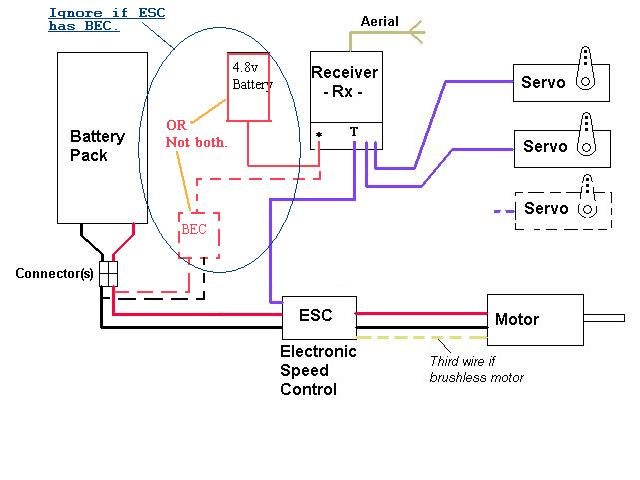
http://www.reddit.com/r/radiocontrol/comments/u7tru/wondering_if_someone_could_look_over_some
And it can be placed
these way:
(except for missing camera and changing motor placement)
(except for missing camera and changing motor placement)

http://www.ruberkon.com/media/catalog/product/cache/1/thumbnail/9df78eab33525d08d6e5fb8d27136e95/m/u/multiplex-solius-inner-look.jpg
Note that the battery
is at the rear of the front set, just below the wings.


